
The Front Porch of the Lowcountry
Barndominium Builders in Walterboro, SC
Barndos and shop houses on farm, timber and hunting land across Colleton County, off I-95 between Charleston and Savannah.
- Free on-site land visits
- Written, line-item estimates
- County wind and permit research included
Rural Land, Big Rivers: Barndominiums in Colleton County
Barndominium builders who look at Walterboro see a county with a lot of land and not many people on it. Walterboro, the Colleton County seat since 1817, is a small city of 5,544 residents (2020) on about 6.8 square miles at an elevation near 30 feet. The county around it is huge, roughly 1,056 square miles of land, and in 2020 some 76.1 percent of Colleton County residents lived in rural areas. The county population was essentially flat over the last decade, 38,892 in 2010 and 38,604 in 2020, which means much of the land is still farms, timber and hunting tracts rather than subdivisions.
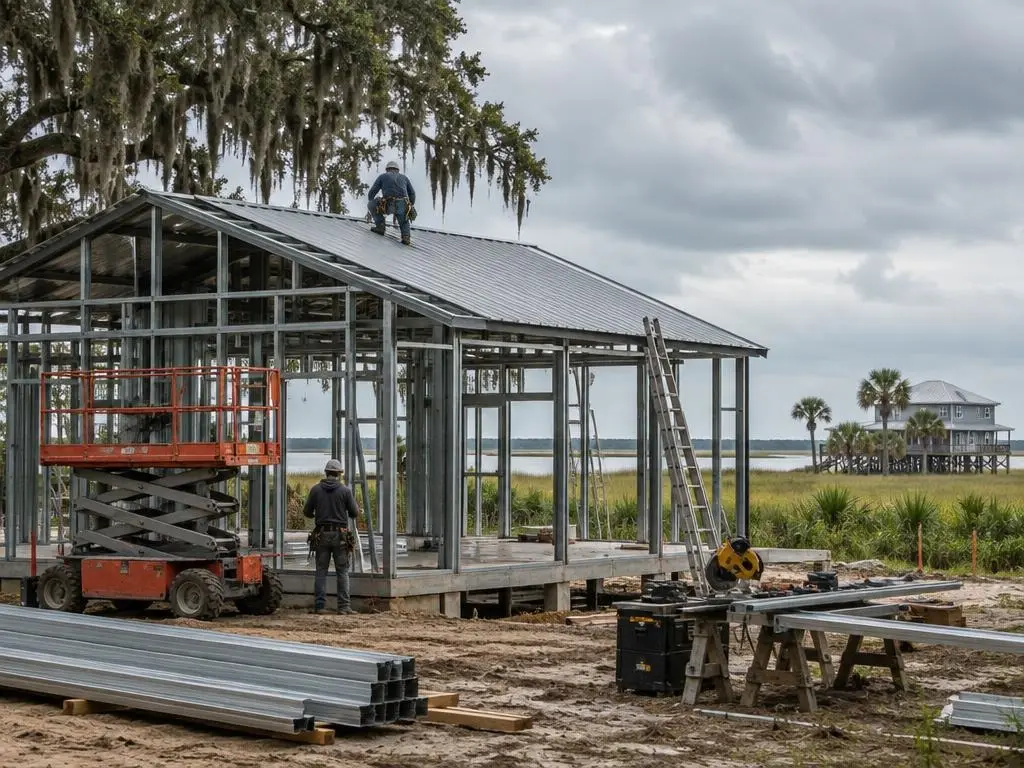
That is the setting a barndominium was made for: a home with a heated shop for tractors, a boat or a hunting rig, on acreage where neighbors are a long way off. Walterboro sits 48 miles west of Charleston, and I-95 passes just west of the city with exits 53 and 57, running 67 miles to Savannah and 110 miles to Florence. Steel deliveries and trades can reach the area without trouble.
Planter retreat to county seat
The town was founded in 1783 as a summer retreat where Lowcountry planters escaped malaria on their plantations. The first settlement was called Hickory Valley, and it was later named for Paul and Jacob Walter, plantation owners from nearby Jacksonboro. The higher, drier ground that drew planters inland is still the kind of ground worth looking for when you choose a house site today.
Four rivers and a coast
Colleton County is defined by water. The Edisto, Ashepoo, Salkehatchie and Combahee rivers cross or bound it, the county reaches the Atlantic and the Intracoastal Waterway, and Edisto Beach became part of the county in 1975. Water covers about 76.8 square miles of the county. Protected land includes Bear Island and Donnelley wildlife management areas, Colleton State Park, part of Givhans Ferry State Park and the St. Helena Sound Heritage Preserve. Tracts that border river swamps or marsh often have low corners in a flood zone, even when the high ground is fine.
How Colleton County handles flood zones
The county's floodplain management office describes Special Flood Hazard Areas in Zones A, AE and VE, with AE and VE called high-risk and VE the coastal high hazard zone. Elevation certificates are required for all structures built in a Special Flood Hazard Area, prepared by a South Carolina surveyor, engineer or architect. Homes must be elevated to the base flood elevation plus one foot. The county participates in the Community Rating System as a Class 7 community, which gives residents a 15 percent discount on flood insurance premiums.
For a barndominium, those rules shape the design in a straightforward way. If any part of the footprint is in an A or AE zone, the living floor goes to at least one foot above base flood elevation. Sometimes the simplest answer is to site the whole building on the highest part of the tract; sometimes it is a raised slab or an elevated living level over a shop. We look at the map before a site is chosen.
High-wind construction
Colleton County's Building Code Administration lists the ICC 600 Standard for Residential Construction in High-Wind Regions among the codes it administers, alongside the 2021 International Fire Code, and it publishes a wind and seismic map for the county. That tells you the county expects homes here to be built for hurricane wind. Statewide, the 2021 International Residential Code with South Carolina modifications applies and has been enforced locally since January 1, 2023. The county notes that construction plans and a building permit are typically required for new work.
On a barndominium that means a frame designed for the mapped wind speed, a roof system with the right fastener pattern, anchored columns and overhead doors rated for the pressure. Those details are cheaper to get right on paper than in the field.
Septic on a farm tract
Outside Walterboro there is rarely sewer. South Carolina law requires site approval and a permit for every septic system, and on property without public or community sewer you need SCDES approval before the county can issue a building permit. Flat Lowcountry ground often has a high water table; the USDA Yonges series, common on nearly level Coastal Plain land in South Carolina, has water within 10 inches of the surface for about six months most years. On a large tract that usually just means choosing the house site where the septic works.
Weather
Walterboro averages about 51.4 inches of rain a year over roughly 99 days, with a mean daily high of 75.3 degrees F. The record high is 107 degrees F and the record low is 0 degrees F, a wider swing than the coast sees. A metal envelope here needs good insulation, a vapor plan and HVAC sized for long, humid summers.
If you own land around Walterboro, or are about to buy, call (803) 784-7083 or
. A plat and the parcel number are enough to get started.Walterboro and Colleton County Facts
- Rural county. 76.1% of Colleton County residents lived in rural areas in 2020; county population was 38,604.
- Flood elevation rule. Homes in Special Flood Hazard Areas must be elevated to base flood elevation plus one foot, with an elevation certificate.
- Flood insurance. Colleton County is a Class 7 Community Rating System community, giving a 15% premium reduction.
- High-wind standard. County Building Code Administration lists ICC 600, the Standard for Residential Construction in High-Wind Regions.
- Town origins. Walterboro was founded in 1783 as a summer retreat for planters and has been county seat since 1817.
Our Services in Walterboro, SC
Walterboro Questions
How high does my barndominium have to sit if part of my land is in a flood zone?
Colleton County requires homes in Special Flood Hazard Areas to be elevated to the base flood elevation plus one foot, with an elevation certificate. Often the issue can be avoided by siting the home on the high ground of the tract.
Do you build on hunting and timber land well outside Walterboro?
Yes. Rural acreage is where most barndominiums go. We need road access good enough for a steel delivery truck and a site that passes the septic evaluation.
Does Colleton County have special wind rules?
The county's building code office lists the ICC 600 high-wind residential standard among the codes it administers and publishes a wind and seismic map. We design the frame and doors for the wind speed at your site.
What comes first, the septic permit or the building permit?
The septic permit. SCDES has to approve the system on land without sewer before the county can issue the building permit.
Free Estimates in Walterboro, SC
Plan a barndominium on your Colleton County land.
Barndominium Builders Near Walterboro
- Barndominium Builders in Columbia, SC
- Barndominium Builders in Lexington, SC
- Barndominium Builders in Irmo, SC
- Barndominium Builders in Chapin, SC
- Barndominium Builders in Camden, SC
- Barndominium Builders in Sumter, SC
- Barndominium Builders in Orangeburg, SC
- Barndominium Builders in Aiken, SC
- Barndominium Builders in North Augusta, SC
- Barndominium Builders in Florence, SC
- Barndominium Builders in Darlington, SC
- Barndominium Builders in Hartsville, SC
- Barndominium Builders in Myrtle Beach, SC
- Barndominium Builders in Conway, SC
- Barndominium Builders in Loris, SC
- Barndominium Builders in Charleston, SC
- Barndominium Builders in Summerville, SC
- Barndominium Builders in Moncks Corner, SC
- Barndominium Builders in Goose Creek, SC
- Barndominium Builders in Beaufort, SC
- Barndominium Builders in Bluffton, SC
- Barndominium Builders in Rock Hill, SC
- Barndominium Builders in Fort Mill, SC
- Barndominium Builders in York, SC
- Barndominium Builders in Lancaster, SC
- Barndominium Builders in Chester, SC
- Barndominium Builders in Newberry, SC
- Barndominium Builders in Greenwood, SC